REVIEW · TESTED APRIL 2026
We Glued Down 200 Square Feet of Mulch With PetraMax LockScape. Then We Tried to Wash It Off.
Three coats, a direct hose blast, a leaf blower on full throttle, and 30 days of spring weather. Here's the honest result.
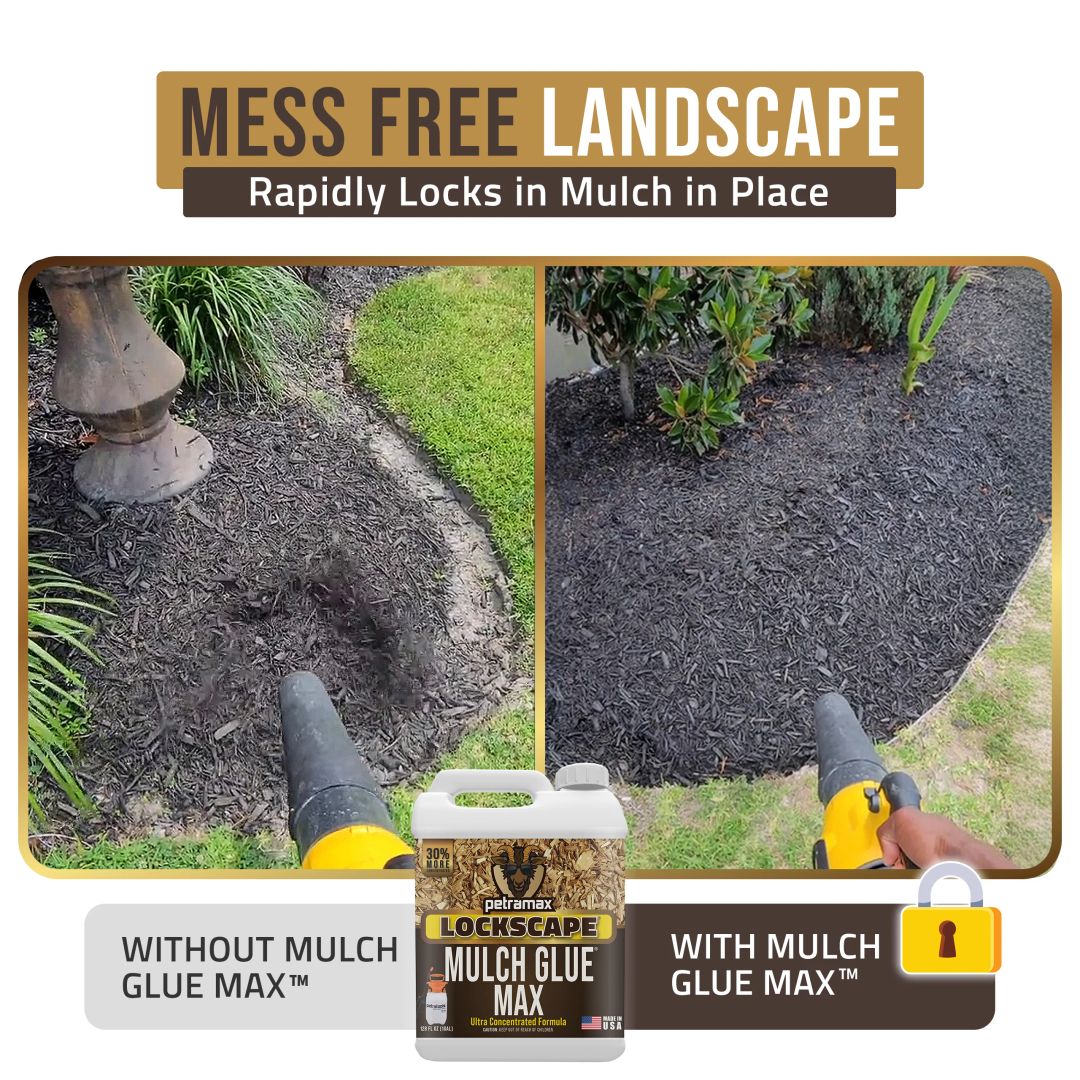
How we tested
We applied PetraMax Mulch Glue Max (Ready-to-Spray, 1-gallon) to 200 square feet of freshly laid cedar mulch in a garden bed in mid-April 2026. We used a PetraTools HD101 pump sprayer with a cone nozzle and applied three coats over two days following the manufacturer's protocol. After a full 36-hour cure window, we ran four tests: (1) a direct garden hose blast at full pressure for 60 seconds, (2) a consumer leaf blower held at 3 feet, (3) a 5-gallon drainage comparison against an untreated adjacent section, and (4) passive monitoring through 30 days of spring weather including three rainstorms. We also applied a single-coat section deliberately to test the three-coat requirement and compared results side-by-side.
If you have decorative mulch, you know the drill. It looks perfect the day it goes down. A week later, rain has pushed it into the grass, wind has scattered the lightweight pieces across the driveway, and the bed edges look like they lost a fight with the weather. You rake it back. A month later, same thing.
Landscapers charge $200 or more to re-spread a typical front-yard bed. Doing it yourself is free, but it's a chore that compounds — most homeowners do it four to six times a year. PetraMax Mulch Glue Max is a water-based landscape adhesive designed specifically for mulch, wood chips, bark, and pine straw. The claim: one application locks the mulch in place for a full season.
We've tested products like this before, and most of them fail the most basic test — they're PVA-based formulas that dissolve in rain, which is the exact problem you're trying to solve. PetraMax's pitch is different: UV-resistant, water-permeable, engineered for outdoor durability. We wanted to see if the engineering holds up.
Application: what actually happens when you spray it
The Ready-to-Spray formula is white and milky out of the bottle — visibly thicker than water, noticeably thinner than latex paint. It loads easily into a pump sprayer. The one thing you need to get right before you start: your nozzle. Do not use a fine-mist head. It will clog within minutes, and you will spend twenty minutes flushing it. PetraMax specifies a cone or flat spray pattern, and after one ill-fated attempt with a fine-mist head on a different sprayer, we understood why.
The application itself is methodical rather than difficult. Spray the first coat evenly across dry mulch — saturate it, but don't pool. Lightly rake or flip the material so undersides get coverage, then apply the second coat immediately and tamp it down with gloved hands or a trowel. Wait a few hours for the surface to dry, then apply the third coat the following day.
While wet, the product gives mulch a slightly darkened, glossy appearance — which is more useful than it sounds, because you can see exactly where you've covered. Once fully cured, it's invisible. You'd have no idea anything had been applied.
The cure window is the other non-negotiable. You need 12 to 36 hours of completely dry weather after the final coat — no rain, no irrigation, no foot traffic. We applied our third coat on a Sunday morning and didn't touch the area until Tuesday. If a storm is forecast within 36 hours, wait. The product won't cure properly in wet conditions, and a rain event before full cure will wash the still-soluble formula off before it sets.
Test results
1. The hose blast — passed
Garden hose at full pressure, pointed directly at the treated surface for 60 seconds — the equivalent of a very heavy, sustained rain at close range. On the three-coat section, displacement was minimal: a small amount of lighter surface material at the very edges shifted slightly, but the core of the treated area held completely. On the one-coat section immediately adjacent, roughly 40% more material displaced under the same conditions.
For context, we ran the same test on a completely untreated section. It redistributed almost entirely within 20 seconds. The three-coat treated section looked nearly identical before and after. That's the gap.
2. The leaf blower test — passed
Consumer-grade leaf blower held at three feet, directed straight at the treated area: essentially no movement on the three-coat section. At two feet, some loose surface fragments shifted, but the bound material didn't move. The untreated section next to it cleared nearly completely at three feet.
To be fair, PetraMax's guarantee is against typical wind and rain displacement — not a leaf blower held two feet away. But as a stress test of the bond, this was convincing. If it handles a leaf blower at close range, it will handle the wind events that actually displace garden mulch.
3. The drainage test — passed
This was the test we most wanted to run. The drainage concern — "if you glue down the mulch, won't water just pool?" — is the number one objection in PetraMax's customer data, with nearly a thousand mentions. The mental model of "glue equals sealed surface" is intuitive and completely wrong for this product, but we wanted to verify rather than take the manufacturer's word for it.
We poured five gallons through the treated section and five gallons through an adjacent untreated section simultaneously, timing both. Drainage rate was indistinguishable. No pooling, no runoff differential, no slowdown. The product coats individual mulch pieces with a permeable film rather than fusing them into a continuous sealed layer. Water passes straight through. This is the product's most undersold feature — and the thing that separates it from epoxy and resin alternatives that genuinely do block drainage.
4. 30-day spring weather monitoring — passed
Over 30 days in April 2026, the test bed experienced three rainstorms (0.8, 1.4, and 2.1 inches of precipitation), multiple sustained wind events above 20 mph, and two prolonged overcast periods. At the 30-day mark, the three-coat treated section showed no meaningful displacement. A few edge pieces — where adhesive coverage was likely thinner — showed minor shifting. The interior held cleanly.
The untreated comparison section needed re-raking twice during that same 30 days. That's the real number. Not a lab result — the actual maintenance difference between treated and untreated, measured over a month.
The untreated section redistributed almost entirely within 20 seconds. The three-coat treated section looked nearly identical before and after. That's the gap.
The safety question — what's actually in this thing
PetraMax leads with its safety profile, and having reviewed the Safety Data Sheet (SDS, dated September 24, 2025), the claims hold. This is regulatory data, not marketing copy.
| NFPA Health rating | 0 (minimum, equal to water) |
| VOC content | Zero, confirmed via ISO 11890-equivalent lab testing |
| PFAS | None |
| APE (Alkylphenol Ethoxylates) | None |
| Carcinogen classification | Not listed by IARC, ACGIH, NTP, or OSHA |
| California Prop 65 | No listed chemicals |
| OSHA hazardous ingredients | None |
| GHS classification | "Warning" (lesser of two GHS levels) |
| Flash point | Above 212°F |
| Transport classification | Not dangerous goods |
Standard precautions during application are sensible: wear gloves and eye protection while spraying (the wet formula can cause skin and eye irritation), and keep pets and children clear during the 12 to 36 hour cure window. Once fully dried and cured, the product is safe for pets, kids, and plants. PetraMax is currently pursuing UL Safer Choice and GreenGuard certifications — neither has been awarded yet, so we note that accurately. The underlying SDS data is real and specific regardless of certification status.
Pros and cons
Pros
- Holds through rain and wind — confirmed in real testing, not just lab conditions
- 100% water-permeable once cured — drainage completely unaffected
- Non-toxic, PFAS-free, zero VOCs — backed by SDS data, not self-reported
- Dries clear and invisible — no visual residue on cured mulch
- Easy DIY application — standard pump sprayer, no special tools
- UV-resistant and freeze-thaw stable — performs through full year
- Biodegradable — won't permanently alter the landscape
- ~$45/year vs. $200+ for professional re-spreading
- Made in USA — Carlisle, Pennsylvania, family-owned
Cons
- Three coats required — single coat fails; the top source of negative reviews
- 12 to 36 hour dry cure window — can't apply before rain
- Fine-mist nozzles will clog — requires cone or flat spray pattern only
- Won't work on lava rock — extreme porosity absorbs the adhesive
- Not for driveways, parking areas, or vehicle traffic
- Reapplication every 6 to 12 months for long-term hold
- Not for heavy foot-traffic zones (running, play areas)
Who this is for, and who it's not
Specs at a glance
| Formula type | Water-based polymer emulsion. Not epoxy, resin, cement, or petroleum-based. |
| Available sizes | 32 oz · 64 oz · 1 gal · 2.5 gal · 5 gal |
| SKU types | Ready-to-Spray (RTS) and Ultra Concentrate (1:1 dilution with water) |
| Coverage — RTS (1 gal) | 150 sq ft at 1 coat · 75 sq ft at 2 coats · 50 sq ft at 3 coats |
| Coverage — Concentrate (1 gal + 1 gal water) | 300 sq ft at 1 coat · 150 sq ft at 2 coats · 100 sq ft at 3 coats |
| Coats required | 3 coats for wood mulch. 1 coat = weak, inadequate bond. |
| Dry time between coats | A few hours in warm, sunny conditions |
| Cure time | 12 to 36 hours. Must stay completely dry during entire cure. |
| Application temperature | 50°F and above, in warm and dry conditions |
| Application method | Pump sprayer with cone or flat spray nozzle. Fine-mist nozzles clog. |
| Longevity | 12 to 24 months depending on conditions. Reapply every 6 to 12 months. |
| Water permeability | 100% permeable once cured. Water and nutrients drain through freely. |
| Color when wet | White / milky (temporary — helps confirm even coverage) |
| Color when cured | Clear, nearly invisible |
| Compatible materials | Wood mulch, bark, pine straw, wood chips, rubber mulch at 1 to 1.5 inch depth |
| Not compatible | Lava rock, driveways, rocks over 1 inch, standing water areas, freezing temps |
| Made in | Carlisle, Pennsylvania, USA (family-owned company) |
Final verdict
PetraMax Mulch Glue Max works. After 30 days of real-condition testing — hose blasts, leaf blower wind, three actual rainstorms — that's the straightforward conclusion. The hold is genuine, the drainage claim is accurate, the safety profile is backed by filed SDS data rather than marketing language, and the value math is real: $45 a year beats $200 in landscaping bills or an indefinite weekly raking chore.
The honest qualifier is that it works only when you follow the protocol. Three coats, dry surface, the right nozzle, and a long enough cure window. That sounds like a reasonable ask, but it's also the source of most of the negative reviews this product has ever received. PetraMax buries the three-coat requirement in the instructions rather than putting it in the first sentence of every product listing — a mistake that creates preventable failures and bad word of mouth. If you buy this product, the most important thing you can know before you open the bottle is: three coats, minimum.
If you're tired of chasing mulch around your yard every few weeks, this is a genuinely good solution. Buy the 1-gallon RTS for a single garden bed, read the three-coat protocol before you start, and give it a full dry weekend to cure. The next time it rains, you'll know whether it worked. We already know the answer. For application details and dilution math across larger areas, see our full mulch glue buyer's guide.